

There are questions most of us usually avoid asking, because the answers tend to unravel everything we’ve built our identity on. Satsang with Aaravindha meets those questions head-on, revealing the truth waiting for you to remember. A Satsang is not a lecture, and it’s not a retreat in the usual sense — it’s a direct encounter, live and unscripted, with a master teacher who has walked this ground and can meet you exactly where you are.
This October in Switzerland, The Living Thread opens five days of that auspicious encounter. The following transcript of a live Q&A is an invitation to consider what it might mean to actually show up and ask about your deeper, more meaningful questions.
Enjoy the read!
“What do you recommend for a beginner on the spiritual path regarding meditation practices, physical exercises, diet and general actions in life? What can I use when I get stuck?”
In order to bring fulfillment to your life in the most profound way, you need to make purification the most important value in your practice. From purification, you become a clear channel. But to purify, you must make certain alignments — and there are two principal ones.
The first is horizontal: the life you live. It is your environment, your friends, your family, your interactions, your work. What you eat, how you exercise. Everything physical.
The second is vertical: you are built from the inside out, and the closer you come to source within, the more purity you attain.
These two paths must be brought into alignment with each other.
Knowledge alone — even true self-knowledge — has little value if it isn’t actualized, if it isn’t walked into life, because it will be forgotten, and forgotten quickly. It has to be wired into the instrument that you are. What you gain in wisdom, you must test in life, practicing fundamental principles known as Punyas, or virtues.
But there is an issue with virtue as it is commonly understood. Much of it is signal virtue, or trending virtue — societally and culturally programmed, so that something is acceptable in one situation and wrong in another. Virtue defined this way remains subject to interpretation, because it is entirely external.
So it is vital to bring yourself as close as possible to source. At the very top of a spiritual life is the integration of the vertical path — which isn’t truly a path at all, since it is really a return to what already is. It is coming more and more into the now. That is, fundamentally, what transcendence means: letting go of everything in the past and everything in the future. Once those things no longer control you, you arrive at a Shamatha place — a place of peace at the center.
When you let go of past and future and settle more fully into the present, reaching that place of Shamatha, of peace, the process of transcendence begins. But it is not simply letting go — there is real art to it, with many distinct elements:
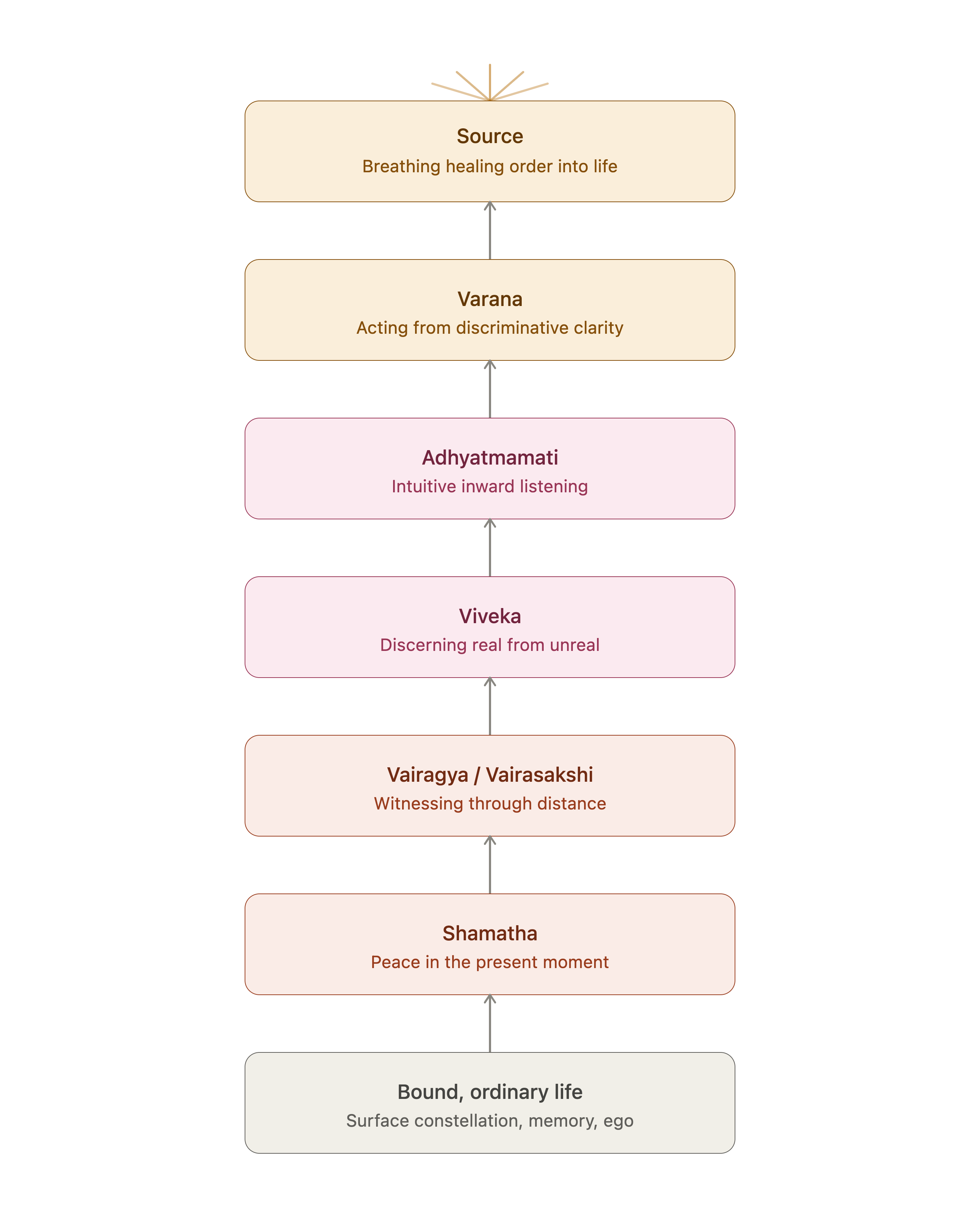
This is only a skeletal description; there is a great deal more to each of these. Together, they describe the process of moving from the surface constellation of your life — where, fundamentally, everyone is bound — through transcendence to source, carrying you past memory, the subconscious, and the unconscious, into supraconsciousness.
Virtue’s role in this is to keep the ground stable, so that you are not sabotaging yourself through its absence. It is part of an all-encompassing journey.
If you pursue spiritual practice only to build a better life for yourself, you are basing that pursuit on the belief that you are not good enough yet, but will be eventually. This puts you into a process of pursuit that is itself a form of self-deception, because pursuit affirms separation. The truth is that you are never separated from source. Truth is always within you. Source is always with you.
The journey, instead, is a matter of letting go of everything you are attached to or averse to — all of it rooted in one great lie: the belief that you know who you are. This is the central question most New Age systems pose: Do you know who you are? That is the doorway to truth. So ask yourself: Who am I? Who am I, really?
Some traditions answer through negation — not this, not that. Others say you are both nothing and everything; the wise will tell you that. You cannot identify with any single perception of yourself, because doing so only fortifies that self. The ego steps in — Ashmita — and insists: this is who I am, this is who I must prove I am, this is who I must defend myself as.
If you don’t believe you’re good enough, your spiritual path becomes an attempt to make yourself someone better. But no matter who you try to be, you will never manage to define yourself, because you cannot be limited by any one thing — and you cannot be limited, either, by claiming to be nothing.
You might instead say you are no thing, no fixed identity, but a divine nature built of creative impulses seeking full manifestation — yet even that you cannot identify with.
So the first and most important task is to stop trying to define yourself. Stop insisting, “This is me, this is who I am.” Whatever answer you arrive at is a lie, because your truth is far too vast to be defined.
Then you might ask instead, “Why am I?” This question sets you free almost immediately, because it initiates inner listening. Simply by being alive, you are being told, through your own expression, bits and pieces of a story that ultimately reveal why you are.
“Why am I?”
It begins with transcendence. And why do you transcend? Because, in the end, you are seeking the subtle currents that flow from source — currents of Ananda bliss. If you can tap into them, surrender to them as they arise in transcendence — once you have released the need to prove who you are, to improve who you are, to re-engineer what you thought you were — genuine listening becomes possible. From that listening, transcendence comes easily, and so does translation. It is not effort, not pursuit, but an opening. It is effortless. And through it, you come closer and closer to source.
As you become pure — a pure vessel — certain principles, Punyas, virtues, begin to show themselves, because you gain the capacity to sense, through transcendental intuition, the difference between what is meant to be and what is not. What is meant to move through you is a presentation of light that dissolves darkness. The closer you come to source, to light, the brighter you become — and that brightness answers the dark. This is your nature.
Everything that seems wrong with life, everything that seems wrong with who you think you are, is ultimately answered by the light present at the very origin of your being. It is always there. The more you let it flow into your life, the more clearly you come to see yourself, and the more you can discriminate for your own nature. You can feel — and this is important — you can intuitively feel what that bliss, what that light, is trying to manifest through you.
Allowing that manifestation is Punya: virtue. From this, certain truths become clear.
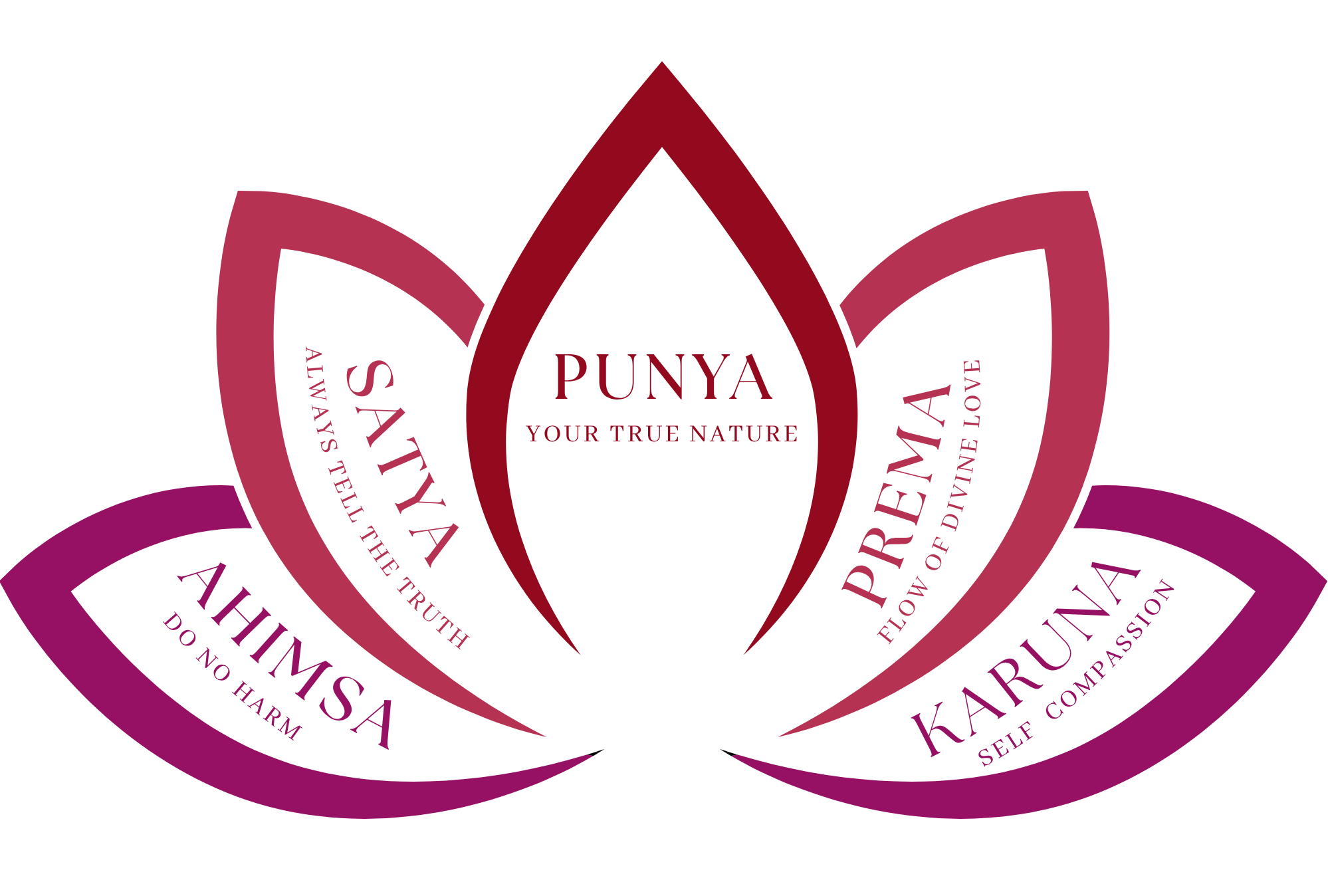
Always look beyond whatever shadow comes to you and recognize the teaching within it, seeking the truth it carries.
When you allow this to move through you, along with all of these Punya impulses, you become a living grace. The will of the father and the power and consciousness of the mother unite to make your life divine — that is the divine life. That union is authentic.
This is not trending virtue, not virtue signaling. Your virtue comes from your essence, not from scripture. Scripture is fine, if you prefer it, but it is always vulnerable to interpretation shaped by the defenses or hopes of the ego — which is why the world holds so many differing versions of truth.
The path is one of finding authenticity in your own essential truth, unbound by the limits of ego. From there, everything becomes clear. Ahimsa becomes: I won’t hurt myself by eating badly, by taking drugs, by acting destructively. Satya becomes something more than simple honesty — I have a truth seeking to be expressed, and it can only happen bit by bit. It is expressing that truth in pieces, not merely being honest.
Your spiritual path is aligning yourself with that divine telling. It is no longer a reflective exercise.
How many times have you heard it — just speak your truth? What truth? Truth itself is perfect. It is absolute. All any of us can do is be honest, and get out of the way, letting truth unravel into the story of our lives. Your spiritual path is aligning yourself with that divine telling. It is no longer a reflective exercise.
You don’t have to practice yoga, though of course there are many kinds — Raja Yoga, Hatha Yoga, and others. These are wonderful, with real health benefits. Dharana, Dhyana, Samadhi, and Pratyahara are vital principles within Raja Yoga and within transcendence more broadly. But everything you do on a spiritual path ultimately serves one purpose: removing the separation between you and your source, because until then, you remain somewhere within the echo of the dream, not at its source.
So, in this beginner’s rulebook, the most important thing to recognize is that everything which comes into being is meant to be expressed, yet remains an echo returning to source — back to dissolution. That moment of dissolution answers itself with an improvement. If you can get out of the way of corrupting that, you are living the perfect spiritual life, and it will carry you to enlightenment.
© Aaravindha Himadra (2025)
Satsang I Oct 18-23, 2026 & Satsang II Oct 25-30, 2026
Landguet Ried/Switzerland
We'd love to see you there!